Who’s winning the sponsorship league table at FIFA World Cup 2026?
partner post by Tracksuit
The brands paying to stand next to football aren’t all getting the same thing for their money. New tracking data sorts the sponsors fans actually rate from the ones still explaining themselves.
A World Cup sponsorship buys you a logo on the perimeter boards and a line in the press release. What it doesn’t buy you, necessarily, is a place in anyone’s head. The boards rotate every thirty seconds. Whether anything stays behind once they’ve gone is a separate question — and, with the tournament on American soil this summer, a more expensive one to get wrong.
So Tracksuit put the question to American adults.
The incumbents are winning, and it isn’t close
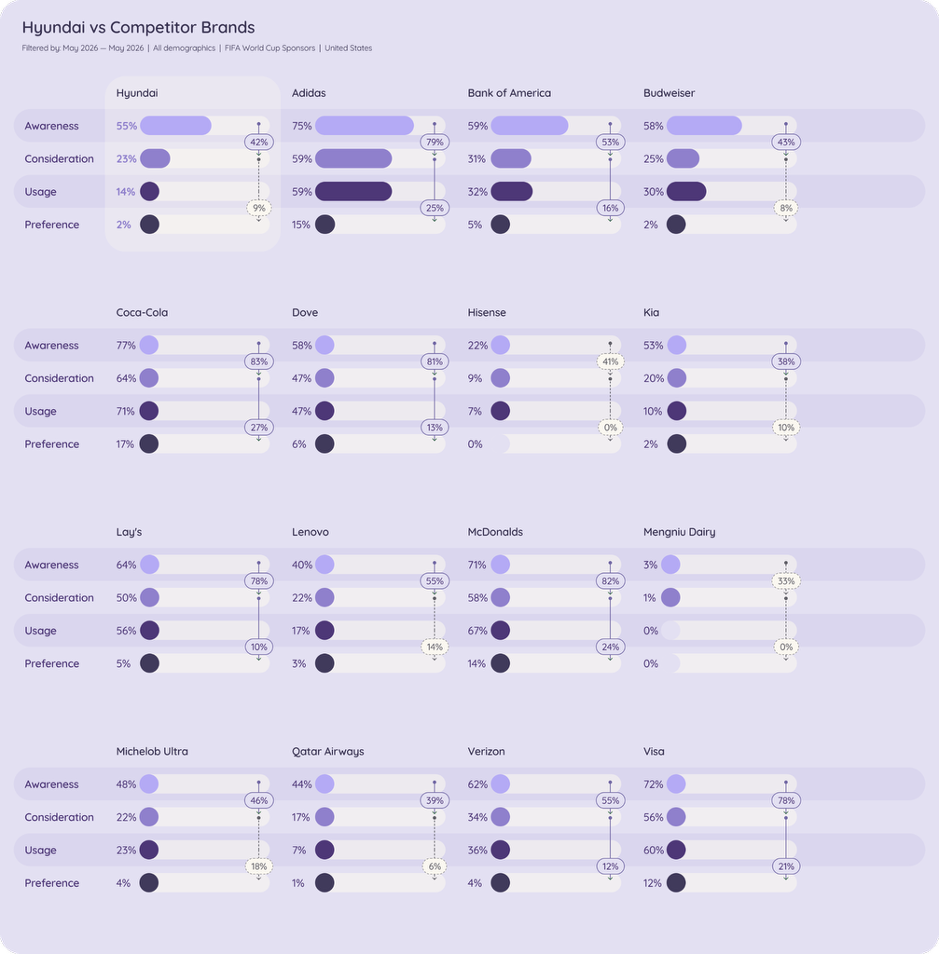
Start with the obvious. Coca-Cola tops awareness at 77%, with Adidas (75%), Visa (72%) and McDonald’s (71%) completing a four-strong group clear of the 70% line. Coke also leads consideration (64%), claimed usage (71%) and outright preference (17%).
Look at who’s clustered at the top of every measure and a pattern emerges that has nothing to do with this year’s campaign budgets. Coca-Cola has sponsored the World Cup since 1978. Adidas since 1970. McDonald’s since 1994. They are the only three brands holding top-three spots on awareness, consideration and preference at once — and they are, more or less, the three that have been there longest.
Sponsorship, it turns out, compounds like interest. The brands that showed up decades ago aren’t paying for attention any more. They bought it years ago and have been collecting the dividend ever since.
source: Tracksuit
Adidas owns the word “football”
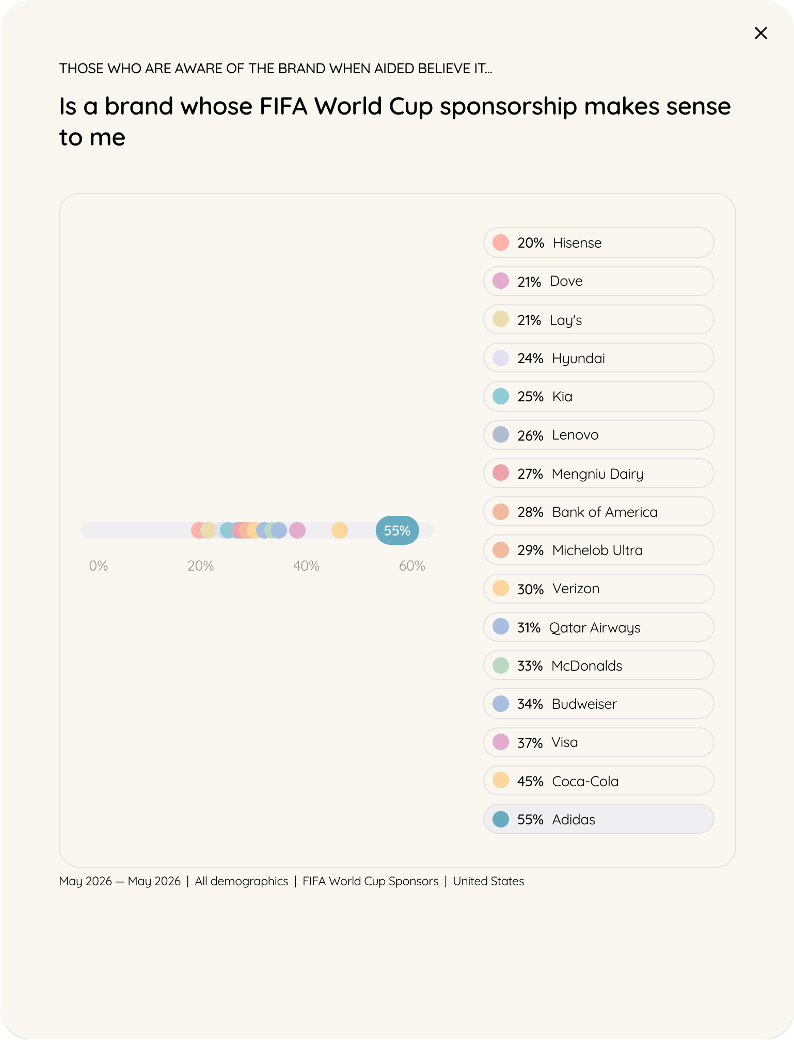
If Coke owns the top of the funnel, Adidas owns the meaning. Ask whether a brand’s involvement “makes sense” and Adidas leads at 55%. Ask whether it’s a brand you associate with winners: Adidas, 39%. Relevant to sit alongside the World Cup: Adidas, 47%. Associate with sport: Adidas at 54%, more than sixteen points clear of anyone else.
This is what half a century of turning up looks like: the brand and the category have fused. Adidas doesn’t have to argue that it belongs at the World Cup. For most people, the question never comes up.
The dairy brand winning on metrics that matter
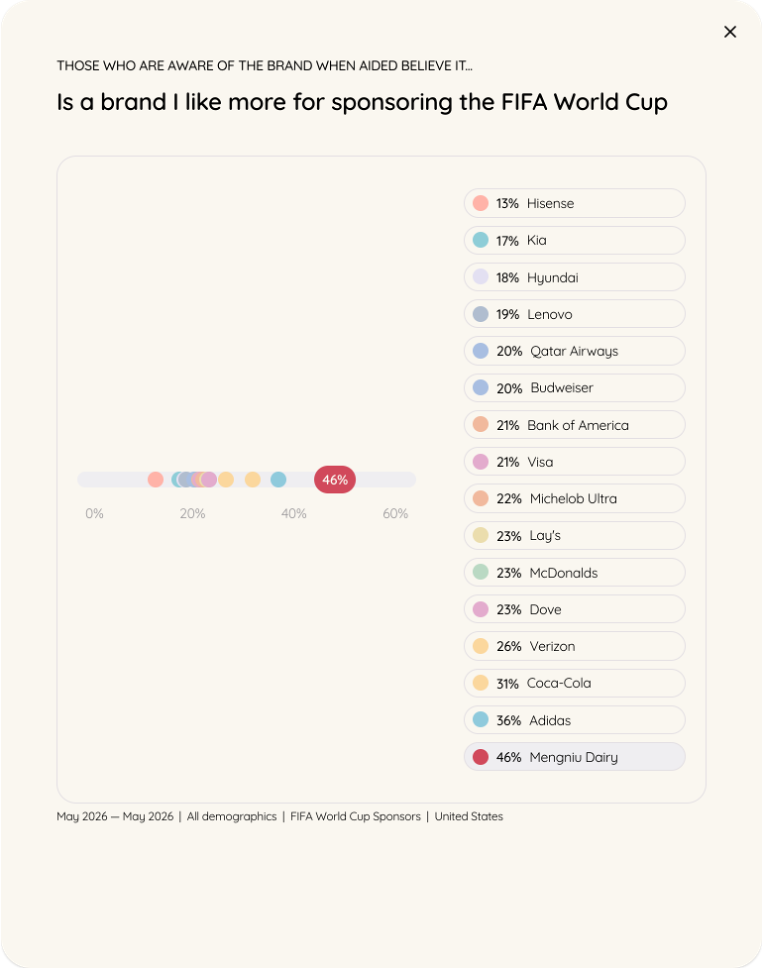
Here’s the line that should make a few CMOs sit up. On “a brand I like more for sponsoring the World Cup” (arguably the truest read on whether the money is doing anything at all) the leader isn’t Coke or Adidas. It’s Mengniu Dairy, the Chinese dairy giant, at 46%.
Mengniu hasn’t got the awareness of the incumbents. But among the people who do know it, the sponsorship is generating real warmth: it lands second on winners (27%) and on relevance (38%) too. That’s the sponsorship dream, in fact: not just being seen, but being thought better of for it. Plenty of brands with five times the recognition can’t say the same.
source: Tracksuit
And then there are the brands still explaining themselves
For everyone else, the World Cup is less a victory lap than a job interview.
Dove sits bottom on relevance (17%) and near the bottom on whether the sponsorship makes sense (21%): a soap brand at a football tournament being, to the average viewer, a non-sequitur it hasn’t yet resolved. Hisense draws the lowest affinity score in the set (13%). Kia (9%) and Lenovo (9%) trail the field on sport association, with Verizon (15%) and Bank of America (16%) not far ahead.
source: Tracksuit
None of this means the money is wasted. It means the narrative work hasn’t been done — and the tournament itself is the obvious place to do it. The prize for a Dove or a Kia isn’t visibility. It’s earning the right to be on the board in the first place.
The bit you can only see if you’re looking
The useful thing about all of this is that none of it is visible from the inside. A sponsor can see its own spend, its own activation, its own gut feel about how the campaign is going. What it can’t see: not without measuring continuously -is whether any of it is shifting awareness, consideration or affinity, or how it stacks up against the brand on the next board along.
Sponsoring a World Cup is the expensive part. Knowing whether it worked is the cheap part — provided someone’s actually tracking it.
Tracksuit is an always-on brand tracking platform. The figures above are drawn from its FIFA World Cup Sponsors category tracking among US adults — a category covering roughly 92.4 million people, or 37% of the adult population.