10 hard truths about Instagram in 2026
By James Herring on Wednesday, January 7, 2026
If you want a clear read on where Instagram is heading for 2026, it’s worth listening to Adam Mosseri.
As the person running the platform, he posted a twenty slide carousel on his IG outlining the ambitions and challenges for the year ahead.
Mosseri’s focus is firmly on AI and what happens when content becomes cheap, plentiful, and increasingly hard to trust.
This isn’t about new features. It’s about how Instagram decides what to surface when originality, realism, and credibility are all under pressure at the same time.
For brands, the message is pretty blunt: polish matters less, behaviour matters more, and who you are is starting to outweigh what you post.
Here are 10 key takeaways for brands from Mosseri’s 2026 outlook.
1. AI will flood the feed. Standing out will get harder, not easier.
Mosseri is realistic about AI accelerating content production. That means volume explodes, attention fragments, and sameness increases. Brands should assume baseline content quality will no longer differentiate. Distinctiveness becomes the job.
Implication: AI raises the floor, not the ceiling.
2. Originality will be rewarded more aggressively
Instagram is increasingly explicit that it wants to rank original content over derivatives. That’s partly cultural, partly defensive against AI remix spam.
Implication: Reposting, templated trends, and watered-down creator mimicry will decay faster in reach.
3. “Authenticity” is no longer aesthetic. It’s behavioural.
Mosseri talks less about how content looks and more about who made it and why. Consistency, history, and intent matter more than polish.
Implication: Brands can’t just look authentic. They need continuity, voice, and memory.
4. Accounts matter more than individual posts
Instagram is shifting from post-level signals to account-level trust signals. Long-term behaviour will outweigh one-off hits.
Implication: Fly-by-night brand stunts may spike, but sustained presence will compound.
5. AI disclosure will be unavoidable
Mosseri is clear that AI-generated content needs labeling, even if detection gets harder over time.
Implication: Brands that try to sneak AI past audiences risk trust erosion. Transparency will outperform cleverness.
6. The feed is no longer the centre of gravity
Private sharing, DMs, and recommendations are doing more of the distribution work than the public grid.
Implication: Brands should optimise for shareability, not just likes. “Would you send this to someone?” becomes the test.
7. Professional polish is losing value
Mosseri repeatedly signals that overly produced content underperforms compared to human-scale, lo-fi, creator-native formats.
Implication: Big budgets need to feel small. Ads that look like ads will keep leaking attention.
8. Creators are not optional distribution anymore
Instagram’s future assumes creators as the primary cultural interpreters of the platform.
Implication: Brands that treat creators as media placements instead of partners will struggle to stay relevant.
9. Trust will become a ranking advantage
As AI muddies reality, Instagram will increasingly reward signals of credibility and provenance.
Implication: Brands with real-world presence, recognisable spokespeople, and consistent narratives will outperform anonymous “content brands.”
10. Speed of adaptation matters more than perfection
Mosseri’s tone isn’t grand vision, it’s urgency. Instagram is iterating in public because the environment is unstable.
Implication: Brands waiting for best practice are already behind. Testing beats planning.
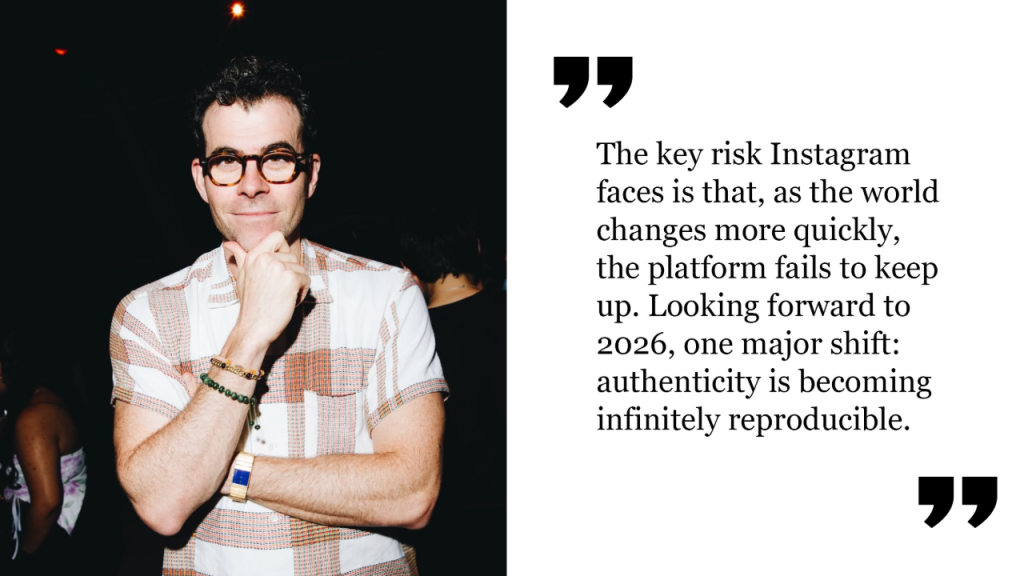
The key risk Instagram faces is that, as the world changes more quickly, the platform fails to keep up.
Looking forward to 2026, one major shift: authenticity is becoming infinitely reproducible.
Here’s a full transcript of his 20 slide carousel
“Everything that made creators matter-the ability to be real, to connect, to have a voice that couldn’t be faked-is now accessible to anyone with the right tools.
Deepfakes are getting better. Al generates photos and videos indistinguishable from captured media.
Power has shifted from institutions to individuals because the internet made it so anyone with a compelling idea could find an audience. The cost of distributing information is zero.
Individuals, not publishers or brands, established that there’s a significant market for content from people. Trust in institutions is at an all-time low. We’ve turned to self-captured content from creators we trust and admire.
We like to complain about “AI slop,” but there’s a lot of amazing Al content. Even the quality AI content has a look though: too slick, skin too smooth. That will change-we’re going to see more realistic Al content.
Authenticity is becoming a scarce resource, driving more demand for creator content, not less. The bar is shifting from “can you create?” to “can you make something that only you could create?”
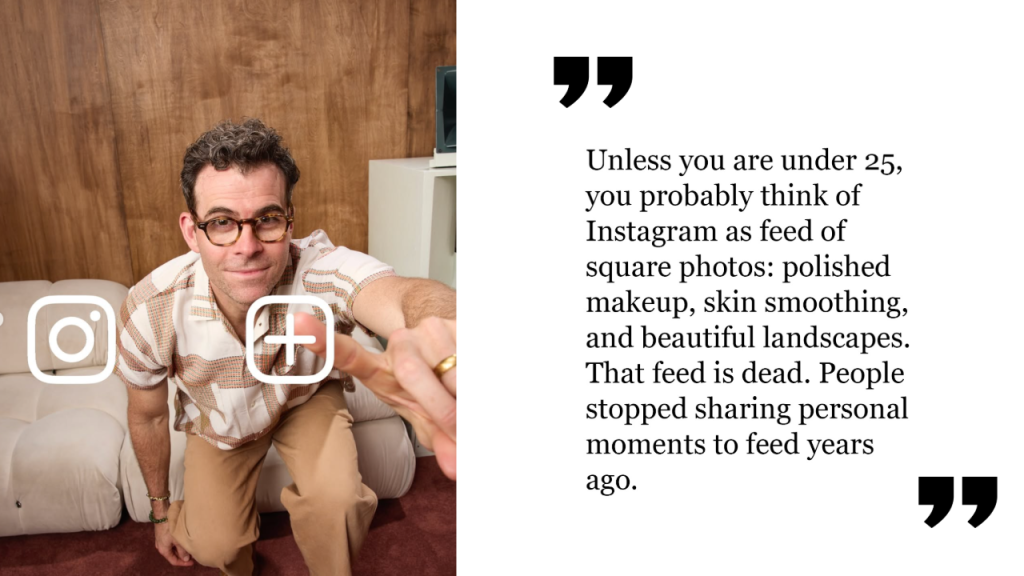
Unless you are under 25, you probably think of Instagram as feed of square photos: polished makeup, skin smoothing, and beautiful landscapes.
That feed is dead. People stopped sharing personal moments to feed years ago.
The primary way people share now is in DMs: blurry photos and shaky videos of daily experiences. Shoe shots and unflattering candids.
This raw aesthetic has bled into public content and across artforms.
The camera companies are betting on the wrong aesthetic. They’re competing to make everyone look like a pro photographer from 2015.
But in a world where AI can generate flawless imagery, the professional look becomes the tell.
Flattering imagery is cheap to produce and boring to consume. People want content that feels real. Savvy creators are leaning into unproduced, unflattering images. In a world where everything can be perfected, imperfection becomes a signal.
Rawness isn’t just aesthetic preference anymore-it’s proof. It’s defensive. A way of saying: this is real because it’s imperfect.
Relatively quickly, Al will create any aesthetic you like, including an imperfect one that presents as authentic. At that point we’ll need to shift our focus to who says something instead of what is being said.
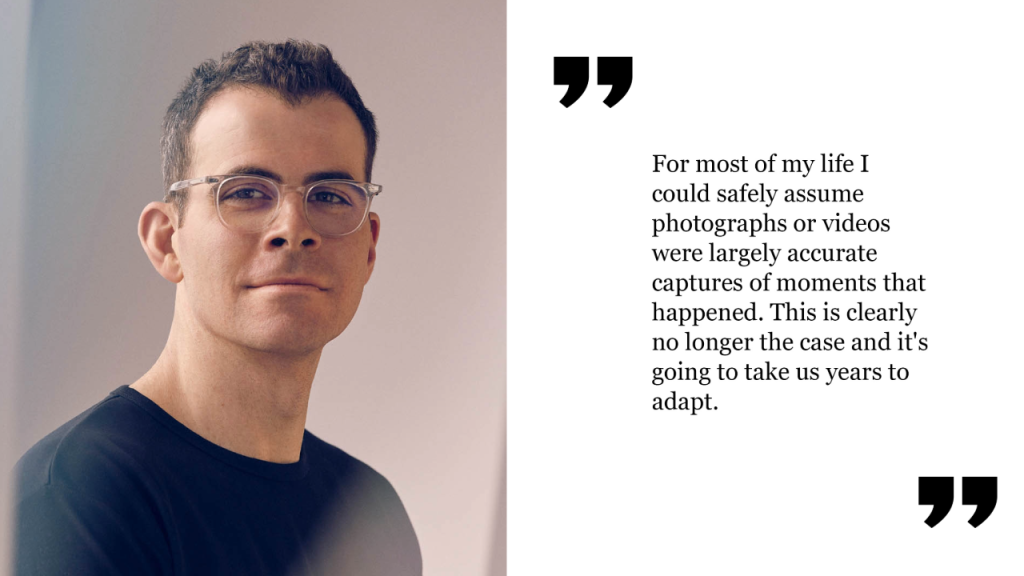
For most of my life I could safely assume photographs or videos were largely accurate captures of moments that happened. This is clearly no longer the case and it’s going to take us years to adapt.
We’re going to move from assuming what we see is real by default, to starting with skepticism. Paying attention to who is sharing something and why. This will be
uncomfortable-we’re genetically predisposed to believing our eyes.
Platforms like Instagram will do good work identifying Al content, but they’ll get worse at it over time as AI gets better. It will be more practical to fingerprint real media than fake media.
Camera manufacturers will cryptographically sign images at capture, creating a chain of custody.
Labeling is only part of the solution. We need to surface much more context about the accounts sharing content so people can make informed decisions. Who is behind the account?
In a world of infinite abundance and infinite doubt, the creators who can maintain trust and signal authenticity-by being real, transparent, and consistent-will stand out.
We need to build the best creative tools. Label Al-generated content and verify authentic content. Surface credibility signals about who’s posting. Continue to improve ranking for originality.
Instagram is going to have to evolve in a number of ways, and fast.”
source: Mosseri Instagram